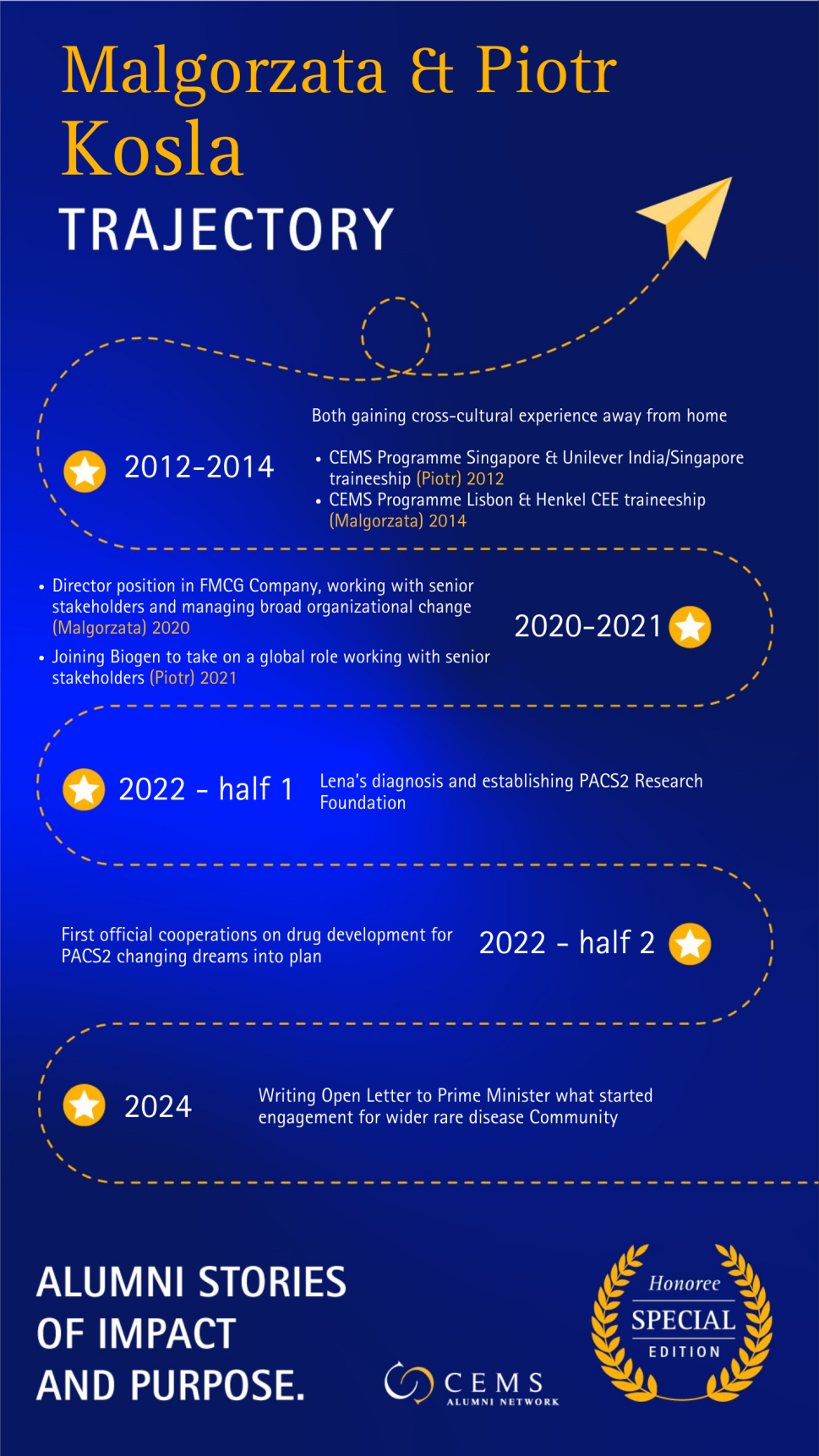
More info
Journey
How did your CEMS experiences and international careers - across healthcare, finance, operations and commercial leadership - prepare you to work across sectors and eventually build a joint initiative together?
CEMS shaped our ability to operate comfortably across borders, disciplines and cultures. The program emphasized systems thinking, ethical leadership and collaboration between business, academia and society—skills that became central to our later work. Our international careers across healthcare, finance, operations and commercial leadership taught us how different sectors think, decide and allocate resources. We learned to translate between scientific, regulatory, financial and human perspectives, and to align diverse stakeholders around a shared goal. This cross-sector fluency, combined with the CEMS mindset of responsibility beyond profit, enabled us to build a joint initiative that connects families, clinicians, researchers and institutions globally, despite operating in very different professional and cultural environments.
Purpose
After a deeply personal turning point, you chose to transform adversity into collective action. What shaped this decision, and how did your sense of purpose evolve along the way?
Facing an ultra-rare disease in our own family confronted us with isolation, lack of knowledge and systemic gaps. Initially, the focus was purely personal—understanding the condition and helping our child. Over time, we realized that many families worldwide were facing the same silence and fragmentation. This realization shifted our mindset from coping to acting. Our sense of purpose evolved from seeking answers for ourselves to creating hope, structure and momentum for a broader community. Transforming adversity into collective action became a way to give meaning to uncertainty—by connecting people, accelerating research and ensuring that no family feels alone when confronted with a diagnosis that medicine has largely overlooked.
Impact
Through the PACS2 Research Foundation, you have built an international, interdisciplinary research network for an ultra-rare disease. What impact are you most proud of so far?
We are most proud of turning an almost unknown genetic condition into a recognized research focus with a growing global community. The Foundation has connected clinicians, geneticists, neuroscientists and families across countries, enabling data sharing, joint studies and a clearer clinical understanding of PACS2-related disease. We helped initiate structured patient registries, supported early-stage research and created a trusted platform where science and lived experience meet. Importantly, families who were once isolated now have access to information, expert networks and a sense of belonging. Building this momentum for an ultra-rare disease—where none existed before—is a tangible step toward future therapies and better care.
Looking Ahead
What does your journey tell us about how globally trained leaders can mobilise expertise, compassion and responsibility to address overlooked societal challenges?
Our journey shows that global education is not only about career mobility, but about responsibility. Leaders trained in international, interdisciplinary environments can mobilize expertise quickly, bridge silos and act where systems fall short. By combining analytical skills with empathy and long-term commitment, it is possible to tackle challenges that lack visibility or commercial incentives. Globally trained leaders are uniquely positioned to convene diverse stakeholders, translate complexity into action and sustain trust across borders. When compassion is paired with professional rigor, even ultra-rare and neglected issues can gain momentum. Our experience highlights that leadership today means using privilege, networks and skills to serve those whose voices are least heard.
In Five Insights – Leadership Takeaways
- One defining decision- To act.
- One risk that changed everything - Investing our time, talents and resources into a cause with no clear roadmap, funding model or guarantee of success.
- One failure that taught me something important - Assuming that scientific progress would naturally accelerate once awareness was raised - real change requires persistence, structure, and constant motivation.
- One belief that shapes leadership - Leadership is not about control, not about understanding everything to the smallest detail, but about creating trust and conditions in which others can contribute their best expertise for a shared purpose.
- One piece of advice to future global leaders - Use your global exposure not only to advance your career, but to take responsibility where systems fail and voices are missing.