BIO
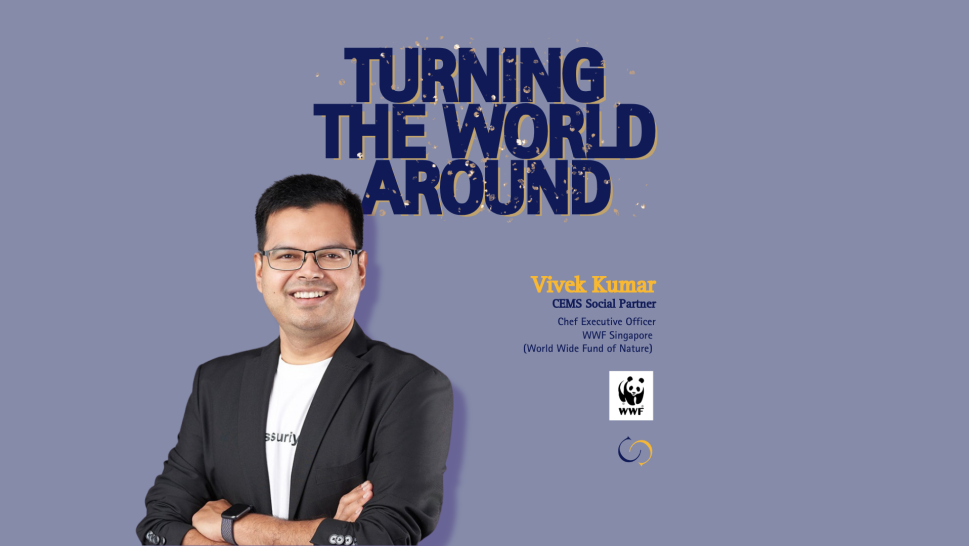
Vivek Kumar: CEO, WWF-Singapore (World Wide Fund for Nature)
Organization: WWF-Singapore
Experience: Group Director, NTUC FairPrice; Assistant Director-General, National Trades Union Congress; Head of Retail Marketing, Shell.
VIVEK, IN TERMS OF SUSTAINABILITY, WHAT KEEPS YOU AWAKE AT NIGHT MOST?
When I think about what keeps me awake at night, it is not worry but the need to stay focused. In a world of fast-moving geopolitical shifts, attention can easily drift to short-term pressures, yet climate and nature remain among the defining long-term risks for our region. We are already working, collectively, to meet critical UN Sustainable Development Goals on climate, biodiversity and responsible production. If we lose focus now, we lose momentum when it matters most.
Nature does not recognise political boundaries, and shared systems only thrive when countries work together. The Sulu–Sulawesi seascape is shared by Indonesia, Malaysia and the Philippines, and forms part of the wider Coral Triangle, one of the most biodiverse marine regions in the world. In this landscape, WWF-Singapore works with our regional offices to coordinate efforts between communities, subject matter experts and governments to restore coral reefs and bolster local livelihoods. It shows what cooperation can achieve, and why weakening cross-border collaboration would set us back.
I also think about sustaining support for work on the ground. WWF-Singapore operates in over 20 countries across Asia Pacific, restoring forests, protecting coastlines and strengthening biodiversity. These projects build real resilience for people and nature, but they depend on continued investment. We need to mobilise far more capital and recognise nature as an asset class that underpins economies, supply chains and long-term stability. When funding tightens, progress slows, and the returns that healthy ecosystems provide start to erode.
At the same time, I see plenty of reasons for optimism. Innovation is accelerating, and the next generation brings real possibility. Through our schools and youth programmes, I meet young people who are creative, driven and deeply committed to solving the dual crisis of climate and nature. Their energy is a reminder that meaningful change is within reach.
YOU MENTION PROJECTS. DOES THE WWF ENGAGE WITH ORGANISATIONS TO DRIVE IMPACT?
Absolutely. We work with organisations across sectors because sustainability is not just good for the planet, it is good for business. When companies make sustainability part of their value proposition, it changes behaviour at scale and directs capital to where it is most needed.
One example is our partnership with Agoda, one of Asia’s largest online travel platforms. This is a consumer-facing collaboration that meets travellers at the moment of choice. We looked at how healthy ecosystems underpin meaningful travel, which shaped our Eco Deals initiative. Now in its fourth year, one dollar from every booking supports WWF’s conservation work, contributing to the protection of elephants in Thailand, tigers in Malaysia and efforts to reduce human–wildlife conflict.
We also work upstream in supply chains, where production choices have long-term consequences. In the Central Annamites of Viet Nam, we partnered with acacia tree smallholders and IKEA to improve timber production through longer growing cycles and certification. Thousands of farmers are now part of the programme, carbon sequestration has risen by around 30 per cent, and livelihoods have become more stable.
Together, these examples show how businesses can create impact from both ends of the value chain: by engaging consumers and by strengthening production systems. When commercial value aligns with environmental stewardship, everyone benefits.
THIS SOUNDS ENCOURAGING. HOW DID YOU PERSONALLY BECOME INVOLVED IN THIS WORK?
I began my career in communications and media, including time in the energy sector, which gave me a strong grounding in navigating complex systems, managing stakeholders and translating technical issues into clear, actionable strategies. These are core skills at WWF, where much of our work involves aligning different actors, shaping narratives around climate and nature, and moving ideas into practical implementation.
As my career developed, I became increasingly interested in roles that connected business, people and long-term development, which led me into the public sector. Working on programmes for young people and the knowledge economy deepened my understanding of behaviour change and systems thinking.
During Covid, I engaged more deeply with environmental issues and that is when WWF came onto my radar. If there is a common thread in my journey, it is the ability to carry transferable skills from one sector into another. Industry experience can help retool an organisation, but it only works when you pair it with a commitment to learn the technical foundations of your new field and apply them with purpose.
IS IT FAIR TO SAY THAT SUSTAINABILITY HAS SHAPED YOUR CAREER – THAT FIGHTING THE GOOD FIGHT, HOWEVER HARD, IS WORTH PURSUING?
My career has taken me from the corporate world to the public sector and now to WWF, and along the way I have become more aware of how organisations influence the communities and environments around them. It is a reminder that shaping a better future is not confined to NGOs; it spans every industry and every organisation.
Across industries, more leaders are recognising that preparing their operations and supply chains for a changing climate is essential for long-term success. This is no longer the job of one team. It affects finance, procurement, operations and strategy. For example, a CFO’s access to capital increasingly depends on how well their company manages environmental and social risks because banks and investors have their own expectations to meet. This shift is visible in sectors like hospitality too. I recently chaired a panel with the COO of Marina Bay Sands, who noted that responsible choices, even in areas like seafood sourcing, are becoming a competitive advantage.
Wherever you are in your career, there is room to understand how your work connects with the world around you. When you do that, you can create value, strengthen your organisation and shape a career with real purpose.
HAVE YOU PERSONALLY FOUND IT REWARDING TO WORK IN A SPACE THAT IS DEDICATED TO SUSTAINABILITY?
It is deeply rewarding, but it can also be challenging. When you work in this space, you see the scale of the climate and nature crises up close. There are days when progress feels slow, but you also see real wins over time, from recovering biodiversity to improved species protection and stronger community resilience. Those moments remind you why the work matters.
What keeps me inspired is the combination of individual dedication and institutional commitment. Across the region, I meet people who return to their communities to protect the landscapes and wildlife they grew up with, whether through nature-based enterprises, national park work or smart sensing systems that help farms and wildlife coexist.
At the same time, I see encouraging signs from institutions. Financial regulators and banks are developing innovative financing mechanisms that support high-integrity carbon projects, restore ecosystems and de-risk investments in nature. These shifts show that systemic change is happening alongside grassroots action.
When you witness that blend of passion on the ground and commitment at the institutional level, it reinforces the belief that meaningful progress is possible.
There are days when progress feels slow, but you also see real wins over time, from recovering biodiversity to improved species protection and stronger community resilience. Those moments remind you why the work matters.
WHAT MESSAGE WOULD YOU SHARE WITH UP-COMING LEADERS – CEMSIES, SAY – ABOUT SUSTAINABILITY?
Three things. First, understand the science. Sustainability and nature conservation can be an emotional space, but good intent must be paired with a clear grasp of the facts. Understand how your decisions, tools or technologies interact with nature, even in sectors like finance or GenAI where the impacts may be less visible. The science is evolving quickly, and leaders need to know which interventions genuinely move the needle for climate and nature. At WWF, we offer learning resources and volunteering opportunities, and I would encourage young people to use them to strengthen their understanding.
Secondly, look for the levers you can influence. You do not need to be in the C-suite to shape procurement choices, suggest lower-impact alternatives or surface risks and opportunities in your team. Sustainability often advances through these everyday decisions, and young leaders who recognise that can help shift organisations in practical and credible ways.
And finally, recognise the people who are doing the hard work on the ground. Be encouraging, stay connected to the insights coming from frontline communities and conservation teams, and pay attention to the organisations driving credible impact. When you acknowledge their efforts and bring those perspectives into your own work or sphere of influence, you help strengthen the broader system.
WHAT ABOUT ORGANISATIONS AND INCUMBENT LEADERS? ANY MESSAGES FOR BUSINESS ON FIGHTING THE GOOD FIGHT?
Leaders need to build real literacy in this space. It is similar to the early days of digital transformation, when everyone discussed it but few understood what it involved. Get closer to the issues, whether that means learning about nature, understanding circularity or simply examining how your operations affect the environment. You do not need to transform everything at once. Start with one meaningful action that fits your organisation’s values.
It is also important to know your footprint. Large companies are making progress, but many SMEs are not. Understanding your energy use, material flows and waste gives you a foundation for better decisions. And when you make changes, be clear about why. That clarity helps distinguish between actions that are meaningful and those that are merely fashionable.
Regulation is tightening across markets. Environmental standards and climate reporting requirements are expanding and will eventually touch every sector. Businesses can move early and strengthen their competitiveness, or wait until compliance becomes unavoidable and more costly. Acting now puts organisations in a much stronger position to operate and grow in a changing global landscape.